ETA: A Nous Paris (you can check the scans at Robert Pattinson France) has an interview with Rob that is the same of Direct Matin interview with a few differences (probably because of the translation). They have an extra question about Life and James Dean. Here’s the translation:
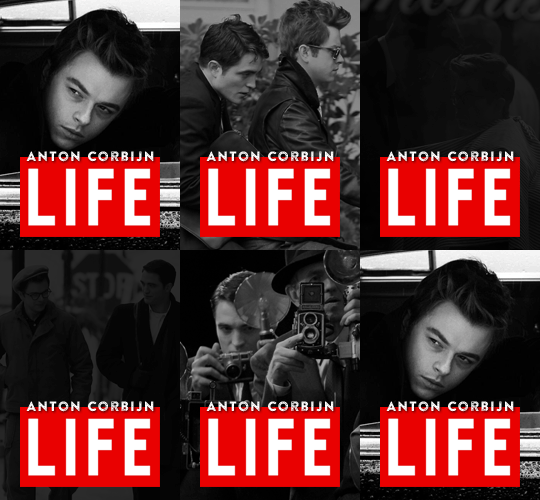
You’re not the one who plays James Dean?
No, it’s Dane Dehaan but it’s funny because there’s similarities to my path, with the fact that everything happened in 2 months, between the moment where he was no one and this incredible success that was dropped on him. The famous picture where we see him smoke at Times Square, it
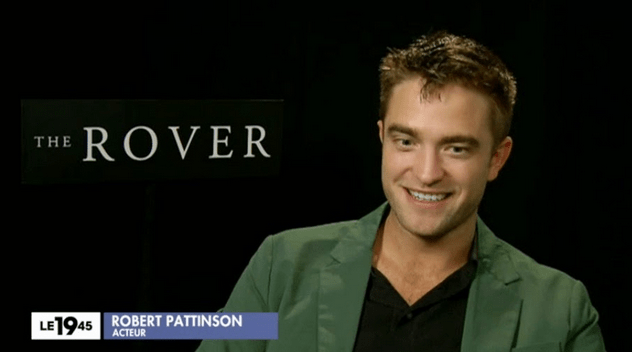
Teen icon at the beginning of his career, Robert Pattinson definitely settled himself in the Hollywood landscape. In ‘The Rover’ by David Michiôd, he plays a simple minded guy forced to work with his enemy to find his brother in the Australian desert. It’s a controlled shift the British actor admits it was made possible thanks to his meeting with David Cronenberg.
Was it the world of ‘The Rover’ or its character that sparked your interest first in the project? I found the script really interesting but I had a really strong connection first with my character, especially the way he express himself. I had never seen a character like this before.
Was it difficult to play someone who’s simple minded? Not at all, it came naturally (laughs). I approached him like a beaten up street dog that would keep on going back to his master for a little bit of affection.
The film imagines a ruined world by men’s madness. Do you think this is where we’re heading with our society?This could happen but I’m more optimistic than that. I have more faith in humanity. In ‘The Rover’, men aren’t completely lost, they all didn’t become mad. Some still have hope and try to revive the Earth. But this economic collapse is totally conceivable.
You play, one after the other, in two movies ‘against the system’: ‘Maps to the Stars’ and ‘The Rover’, are you engaged in politically? I’m more or less liberal.It’s hard to be an actor and not be liberal by the way. Maybe we should be more worried about the oceans but I don’t take politics very seriously. When you see that most Western countries are under the leadership of a handful of multinational companies, it seems like voting is some kind of a joke.
From teens’ sex symbol to an actor seeked by the biggest directors, what was the secret to your career change?
It took some time. It’s been 4-5 years that I’ve tried to create priviledged relationships with directors whose work I’ve admired and it appeared that things settled at the same time. ‘Cosmopolis’ changed everything. Ever since my meeting with David Cronenberg, my career took a new turn.
You were in Cannes with two movies: ‘The Rover’ and ‘Maps to the Stars’ by David Cronenberg. It’s one of the most exhilarating places to screen a movie. There’s an incredible energy that dominates over there. I like doing press at Cannes. The journalists are actually interested in the movies and don’t ask you questions like ‘What’s your favorite food?’ In France, journalists love the cinema.
You just finished filming Werner Herzog’s movie ‘Queen of the Desert’ about the spy, Gertrude Bell. Who do you play in it? I play the young Lawrence of Arabia. He was a close friend of Gertrude Bell during WWI.
You also play the photographer, Dennis Stock in ‘Life’ by Anton Corbijn. We just got done shooting. I saw the trailer the other day. I play this guy who photographed James Dean right before he became famous. James was unknown at that time.
What else do you have planned? In November, I’m working with Olivier Assayas in a movie called ‘Idol’s Eye’. It’s a gangster movie on the true story of a group of thieves who robbed a pawnbroker’s shop that belonged to the mafia. It takes place in the 1970s. I met Olivier Assayas two and a half years ago but the project only came to be a few months ago.
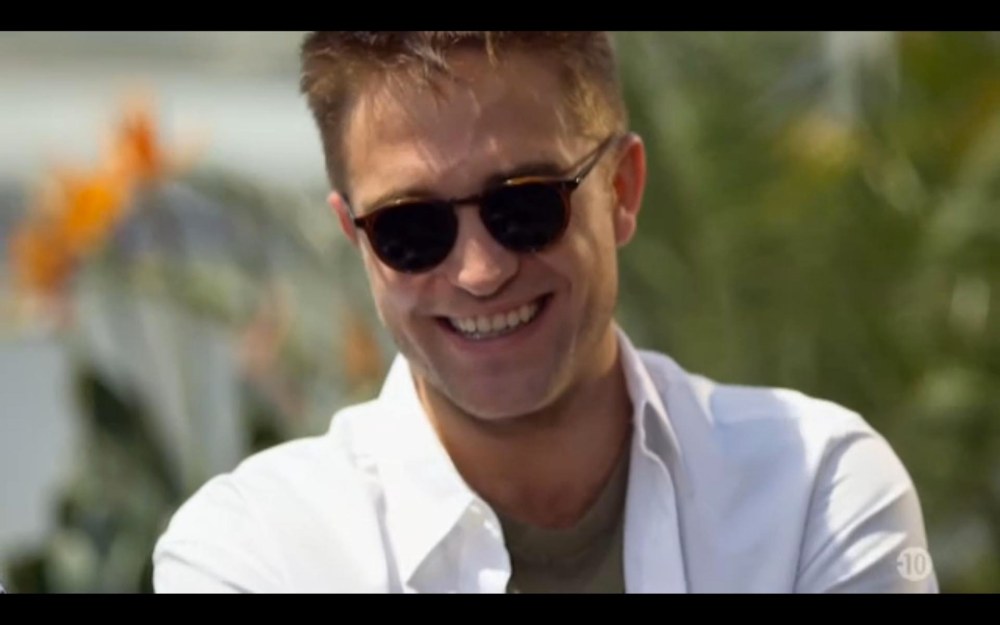
It’s dubbed, but you can hear him. 1st question – he talks about the world situation in The Rover. 2nd question – he talks about working with great directors. “After Cosmopolis I realized that if you just work with great directors, you’ll never be disappointed”
Translation:
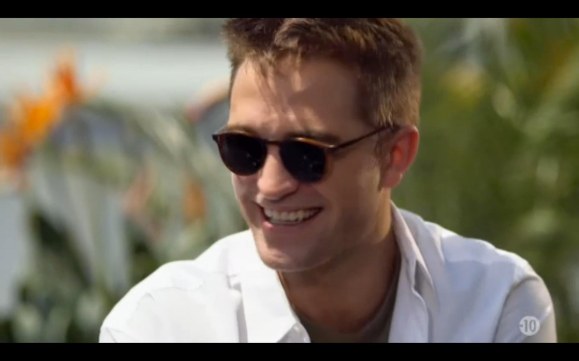
Didier: Watching the film I remembered something I had read somewhere saying the apocalypse is when human beings are losing their humanity. Do you think the film is speaking about that? Rob: Yeah I mean. I guess it’s also … I was thinking a little bit about hope. People have lost the sense of hope with each character and I think it’s where they are living, if the world is devastated just like that. Either it’s economically speaking or extracted inside the world. There’s nowhere to go for people. We’re watching them and we’re wondering how we can live without hope. Is there a reason to live? And I don’t know if the film is telling about that but it’s rather flexible how you can interpret it
Didier: I like what you are doing with your career after Twilight. I know you love cinema, we already talked about that. When you choose a project like this one or a Cronenberg, is it a way to put your love for the cinema in your work? Rob: Yeah I mean, basically after Cosmopolis I realized that if you only work with great directors, you’ll be never disappointed. No matter what the result is, it’s always an amazing experience.
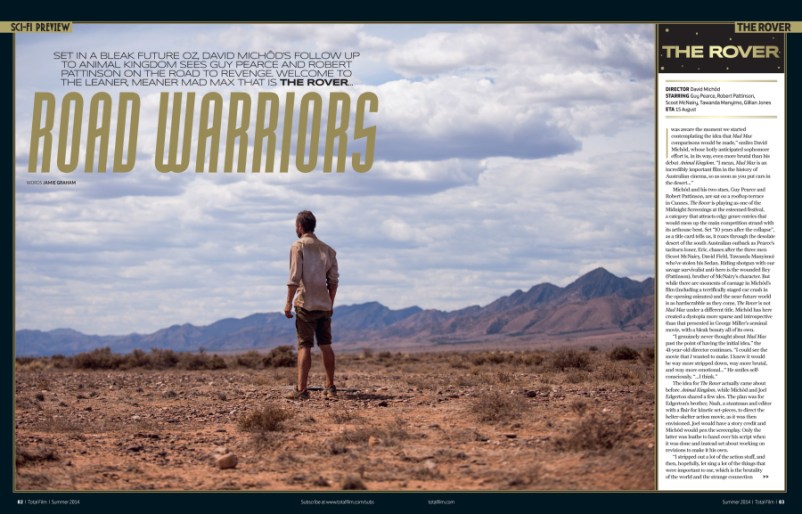
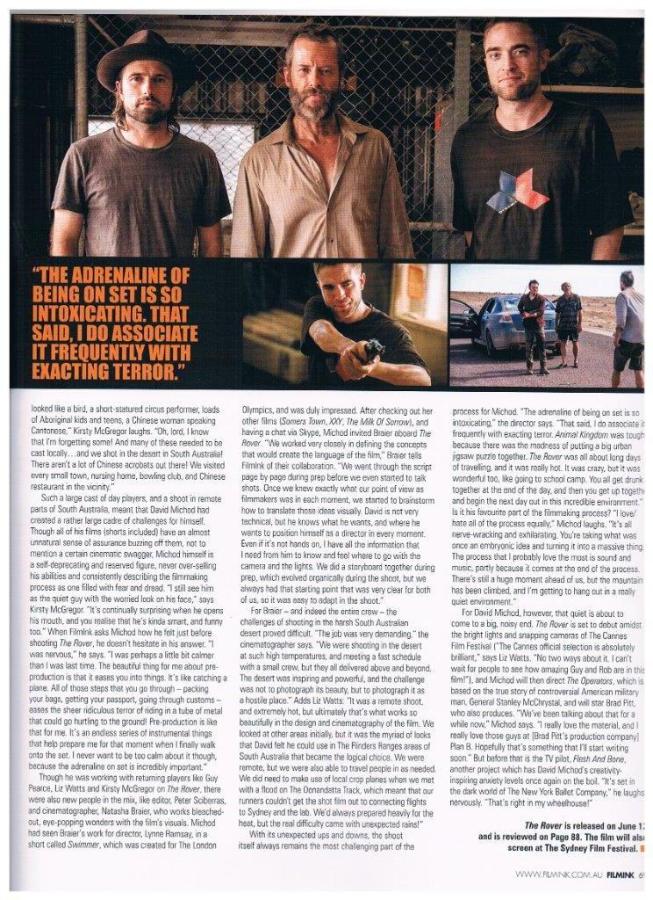
New Robert Pattinson, Guy Pearce and David Michôd interview with ‘Total Film’
Transcript
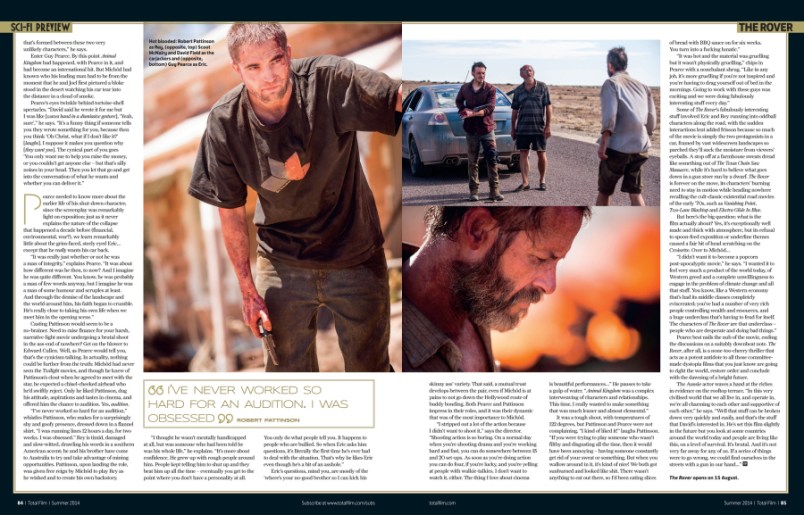
Michôd had never seen the Twilight movies, and though he knew of Pattinson’s clout when he agreed to meet with the star, he expected a chilsel-cheeked airhead who he’d swiftly reject. Only he liked Pattinson, dug his attitude, aspirations and taste in cinema, and offered him the chance to audition. Yes, audition.
“I’ve never worked so hard for an audition,” whistles Pattinson, who makes for a surprisingly shy and goofy presence, dressed down in a flannel shirt. “I was running lines 12 hours a day, for two weeks. I was obsessed.” Rey is timid, damaged and slow-witted, drawling his words in southern American accent; he and his brother have come to Australia to try and take advantage of mining opportunities. Pattinson, upon lading the role, was given free reign by Michôd to play Rey as he wished and create his own backstory.
“I thought he wasn’t mentally handicapped at all, but was someone who had been told he was his whole life,” he explains. “It’s more about confidence. He grew up with rough people around him. People kept telling him to shut up and they beat him up all the time – eventually you get to the point where you don’t have a personality at all. You only do what people tell you. It happens to people who are bullied. So when Eric asks him questions, it’s literally the first time he’s ever had to deal with the situation. That’s why he likes Eric even though he’s a bit of an asshole.”
Eric’s questions, mind you, are mostly of the ‘where’s your no-good brother so I can kick his skinny ass’ variety. That said, a mutual trust develops between the pair, even if Michôd is at pains to not go down the Hollywood route of buddy bonding. Both Pearce and Pattinson impress in their roles, and it was their dynamic that was of the most importance to Michôd.
(…)
It was a tough shoot, with temperatures of 122 degrees, but Pattinson and Pearce were not complaining. “I kind of liked it!” laughs Pattinson. “If you were trying to play someone who wasn’t filthy and disgusting all the time, then it would have been annoying – having someone constantly get rid of your sweat or something. But when you wallow around in it, it’s kind of nice! We both got sunburned and looked like shit. There wasn’t anything to eat out there, so I’d been eating slices of bread with BBQ sauce on for six weeks. You turn into a fucking lunatic.”
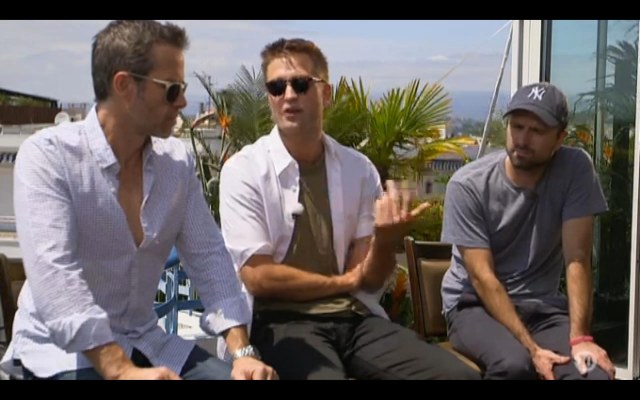
Laurent: Guy, Robert and David , thanks for being with us today. You’re here to talk about your upcoming movie, The Rover. First of all, David, I want to know how you manage to shoot a movie who is a thriller, an action movie, a survivor movie, a road trip with strong characters. It’s amazing. What was your first motivation when you decided to direct this movie? David: The 1st idea was very simple : just about a man in the desert who got his car stolen. Then I started building everything else around this idea. Throughout the screenplay writing, it became a mixture of various different elements. This movie looks like a western. What I really wanted to do was that the audience could feel something. During the shooting , it happened a lot for me that , after watching the dailies , I was like “What is this movie I’m doing? What is it ? It’ really weird”.
Laurent: Guy , was it a constant work on your character everyday? Guy: Actually I talked a lot with David abt who was this man , what he lived before you met him at the beginning of the movie. For me, most of my work was done during rehearsal during our talks in order to really get who the character was. Of course, when you’re doing a movie, the shooting is always a work in progress. You know which way you’re heading but it ‘s rather how you do it to get there.
Robert Pattinson
c/o Curtis Brown Group Ltd.
Haymarket House
5th Floor, 28-29
Haymarket
London, SW1Y 4SP
England
or
Robert Pattinson
c/o Endeavor Agency
Stephanie Ritz
9601 Wilshire Blvd. Floor 3
Beverly Hills, CA 90210
USA
Calendar
April 2026
M
T
W
T
F
S
S
1
2
3
4
5
6
7
8
9
10
11
12
13
14
15
16
17
18
19
20
21
22
23
24
25
26
27
28
29
30
Partners
DISCLAIMER
Thinking of Rob is not affiliated with Robert Pattinson or his management in any way.
There is no copyright infringement intended on this blog. If you are the original owner of any media used and would like it removed, we will be happy to do so, please contact us.
Copyright and Trademark Notice
All original content on this site, including any manipulations or enhancements, is the sole copyright of ThinkingofRob™ and ToR™.













 Thinking of Rob